There was a time when a well-made coat was passed down through generations, and a home-cooked meal was the focal point of the day. Today, you can order a neon-green polyester top for $4.99 while simultaneously having a soggy, lukewarm burger delivered to your door in fifteen minutes. We have optimized our entire civilization for speed and cheapness, completely ignoring the fact that what we are actually buying is garbage.
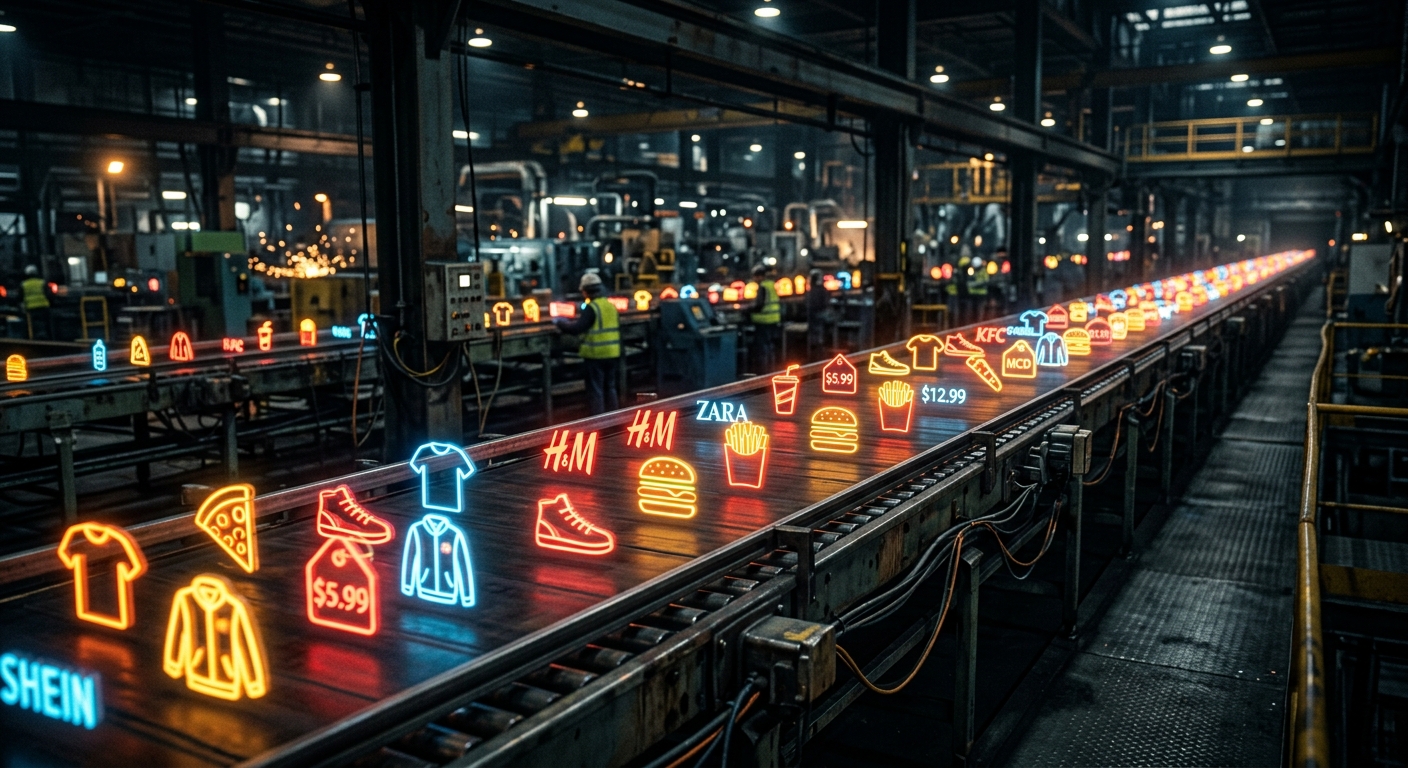
The Illusion of Abundance
The fast fashion and fast food industries share the exact same psychological playbook. They both sell the illusion of abundance to mask the reality of scarcity. You look in your closet, and it is overflowing with clothes. You have 50 shirts, 20 pairs of pants, and a dozen pairs of shoes. Yet, you stare at the pile and say, “I have nothing to wear.”
Why? Because fast fashion isn’t designed to be worn; it is designed to be purchased. The dopamine hit comes from the transaction, not the utility. The fabric is paper-thin, the stitching unravels after three washes, and the style is outdated within a month. It is clothing engineered for obsolescence. You buy a $10 shirt, it falls apart, you throw it in a landfill, and you buy another one. You feel like you are getting a deal, but you are actually trapped in an expensive cycle of perpetual consumption.
The same goes for fast food. You eat a 1,200-calorie meal that costs $8. Your stomach is physically full, but your body is nutritionally starving. Two hours later, you are hungry again. The food is engineered with exact ratios of salt, sugar, and fat to trigger the reward centers in your brain, completely bypassing your body’s natural satiety signals.
The True Cost of Cheap
We love a bargain. But the iron law of economics states that if something is incredibly cheap, someone, somewhere, is paying the difference. In the case of fast fashion and fast food, the cost is simply externalized.
When you buy a $5 t-shirt, you are essentially subsidizing a sweatshop in a developing nation where the environmental regulations are nonexistent and the labor is exploited. The true cost is paid in toxic rivers, microplastics in the ocean, and human suffering.
When you buy a $2 cheeseburger, you are subsidizing a deeply broken agricultural system. You are paying for factory farming, soil depletion, and a healthcare system that will eventually have to treat the diabetes and heart disease caused by the standard Western diet. The burger isn’t cheap; the bill is just being passed to your future self.
The Devaluation of Quality
The most insidious effect of the fast economy is that it has completely recalibrated our understanding of value. We have forgotten what quality feels like. We look at a well-made, ethically sourced pair of boots that costs $300 and we scoff, thinking it’s a ripoff. We would rather buy a $40 pair of boots six times over the next five years, ultimately spending more money for an inferior experience.

We have traded craftsmanship for convenience. We have traded nourishment for flavor dust. This mindset bleeds into the rest of our lives. If we expect our clothes to be disposable and our food to be instantaneous, we start treating everything else the same way. We want fast results in our careers. We want fast fixes for our mental health. We want relationships that require zero friction.
If you want to explore how our desire for instant gratification is being weaponized across the entire economy, check out our deep dive on Society on Chains regarding the dopamine economy and how we are trading long-term goals for short-term hits.
Breaking the Fast
Escaping the cheap chains requires a fundamental shift in how you view consumption. It requires adopting a philosophy of “fewer, but better.”
Stop treating shopping as a hobby. When you need clothes, save up and buy one high-quality piece that will last for a decade. Learn to repair things instead of throwing them away. When it comes to food, reacquaint yourself with your kitchen. The simple act of chopping vegetables and cooking a meal from scratch is an act of rebellion against an industry that wants you dependent on the drive-thru window.
The corporations selling you cheap garbage don’t care about you. They care about volume. They want you hungry, they want you dissatisfied, and they want you coming back for more. The only way to win is to stop swallowing what they are serving.