Picture this: It’s the year 1800. A man owes money he can’t pay, so they throw him in a literal dungeon. It was called a debtor’s prison. Fast forward to today, and we look back at that practice and say, “Wow, how barbaric! How uncivilized!” Then we check our smartphones, see our credit score dropped by 15 points because we utilized too much of our available credit, and suddenly we realize we can’t get a car loan, rent an apartment, or even secure a cell phone plan. Welcome to the modern era, where we haven’t abolished the debtor’s prison—we’ve just made the walls invisible.
The Birth of the Number
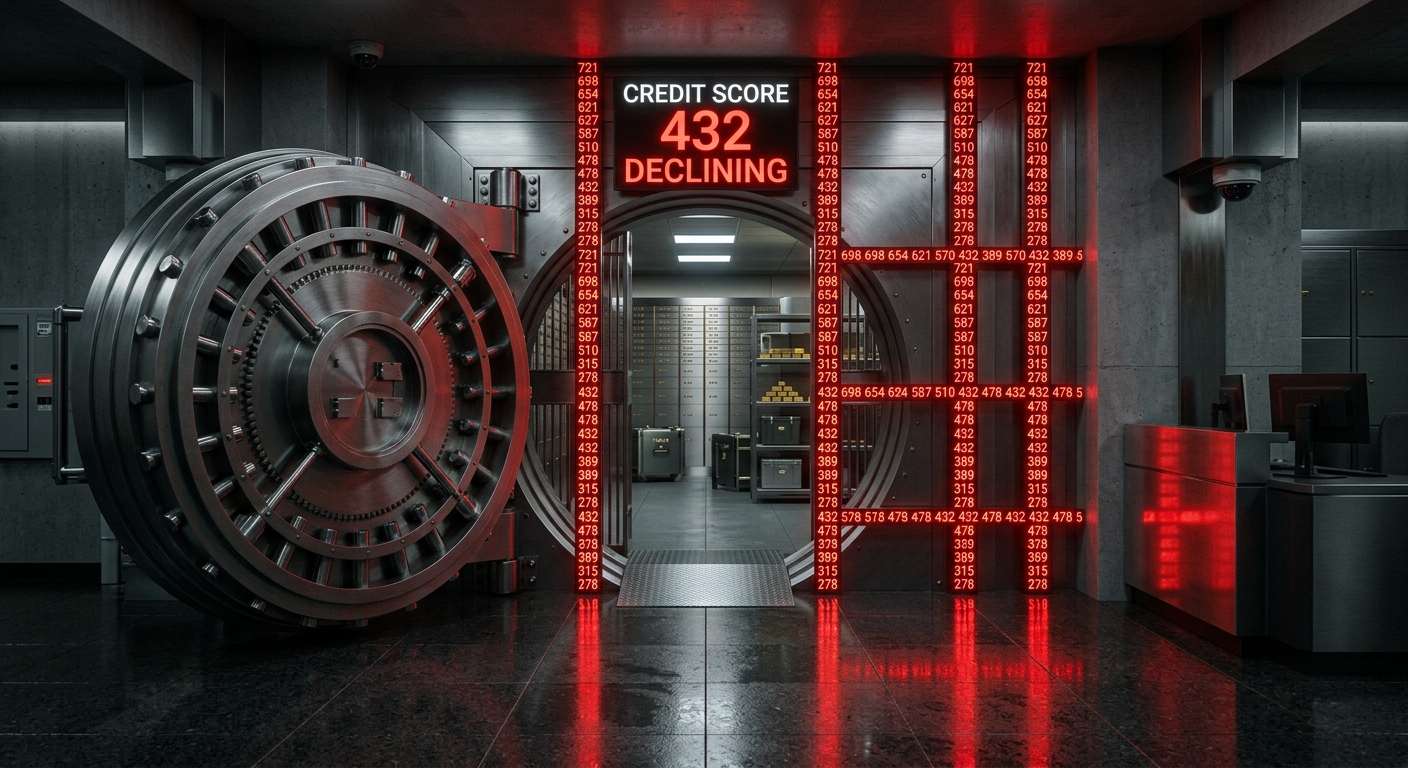
Most people treat the credit score like it’s a natural law of physics, something handed down on stone tablets at the dawn of time. Here’s a fun fact: the FICO score as we know it didn’t even exist until 1989. For thousands of years of human history, your ability to borrow money was based on your reputation, your community standing, and your actual assets. Today, your entire financial existence is boiled down to a three-digit number algorithmically calculated by three shadowy private corporations.
Think about the sheer power we have surrendered to Experian, TransUnion, and Equifax. They are not government entities. They are for-profit data brokers who collect your financial information—often without your explicit consent—package it, and sell it back to lenders. You are their product, but you are also their prisoner.
We are told that a credit score is a measure of financial responsibility. But is it? A person who lives entirely within their means, pays in cash, has zero debt, and saves half their income will have a terrible credit score. Why? Because the system doesn’t measure responsibility. It measures profitability. The credit score is a metric of how good of a sheep you are to the financial industry. It measures how effectively they can extract interest payments from you over time without you defaulting.
The Chains of “Good Debt”
We’ve been brainwashed into a twisted Stockholm syndrome regarding debt. Financial advisors go on TV and talk about “good debt” versus “bad debt.” A mortgage is good debt! A student loan is good debt! But let’s strip away the euphemisms. Debt is a claim on your future labor. When you take out a 30-year mortgage, you are essentially pre-selling the next three decades of your life’s energy to a bank.

The system is brilliantly designed to trap you early. We tell 18-year-olds—who legally cannot buy a beer—to take out $100,000 in non-dischargeable loans for a degree that might earn them $45,000 a year. Then we hand them a shiny piece of plastic with a 24% interest rate and say, “Go build your credit!” It’s like throwing someone into the ocean and telling them to build a boat.
And once you are in the system, the algorithm watches your every move. Did you close an old account? Penalty. Did you apply for a new card? Penalty. Did your credit utilization ratio inch above 30% because your car broke down and you had to put the repairs on a card? Penalty. You live in constant fear of angering the numerical gods. The anxiety is the point. The anxiety keeps you compliant. An employee with a mountain of debt and a fragile 680 credit score isn’t going to go on strike. They aren’t going to quit to start their own business. They are going to put their head down, drink their coffee, and keep grinding the wheel.
The Panopticon of Finance
The true genius of the credit score is how it functions as a societal control mechanism. In recent years, employers have started running credit checks on job applicants. Landlords won’t rent to you without a pristine score. Car insurance premiums are tied to your credit tier. The number isn’t just about borrowing money anymore; it’s a social passport.

If your score drops, your world shrinks. Opportunities evaporate. Interest rates spike, creating a death spiral where poverty literally becomes more expensive. The poorer you are, the more it costs to exist. The debt machine punishes those who stumble and rewards those who are already wealthy, solidifying class divides under the guise of an objective mathematical formula.
In China, they have explicitly rolled out a “social credit score” that openly monitors behavior. Western commentators love to point at it and gasp at the authoritarianism. But look in the mirror. We’ve had a financial social credit score for decades; ours is just managed by Wall Street instead of Beijing.
Breaking the Invisible Chains
So, how do you beat a system that is rigged against you? The first step is rejecting the premise. Stop treating a high credit score like a moral virtue. It’s a game, and the only way to win is to stop playing by their rules.

Pay off your debts with furious intensity. Live below your means. Build an emergency fund so robust that you never have to ask a bank for permission to survive a crisis. If you must use credit cards, treat them like loaded weapons—pay the balance in full every single month. Starve the beast of the interest payments it needs to survive.
To dive deeper into the systems that keep us tethered and how to truly reclaim your autonomy, explore our other articles at Society on Chains. We unpack the hidden infrastructure of modern society and provide the tools to build a life outside the matrix.
The Final Tally
The debt machine is the most effective form of widespread control ever invented. It doesn’t require guards, or batons, or physical walls. It only requires your participation. The chains are digital, the locks are algorithmic, but the imprisonment is real.
It’s time to stop begging the warden for a better score. It’s time to break the chains.